After the Constitution Amendment
Updated: Jul 11
A concluding reflection on Zimbabwe's Constitution Amendment Bill No. 3
When I first began writing about Constitution Amendment Bill No. 3 earlier this year, the proposals existed only on paper.
Today, that journey has come to an end. The Bill has been approved by both Houses of Parliament, and President Emmerson Mnangagwa has assented to the legislation. The amendments are now part of Zimbabwe's constitutional framework.
The legislative process is over.
However, the constitutional consequences are only beginning.
Although legal arguments and debate may yet continue over aspects of the amendment process, the political reality is that Zimbabwe's constitutional landscape has now changed in a profound and lasting way.
Throughout this series of articles, I have deliberately tried to avoid approaching this issue through a party-political lens. Governments come and go. Constitutions remain. Or at least they should.
My concern has never centred upon one individual or one political party.
It has centred upon a far more enduring question.
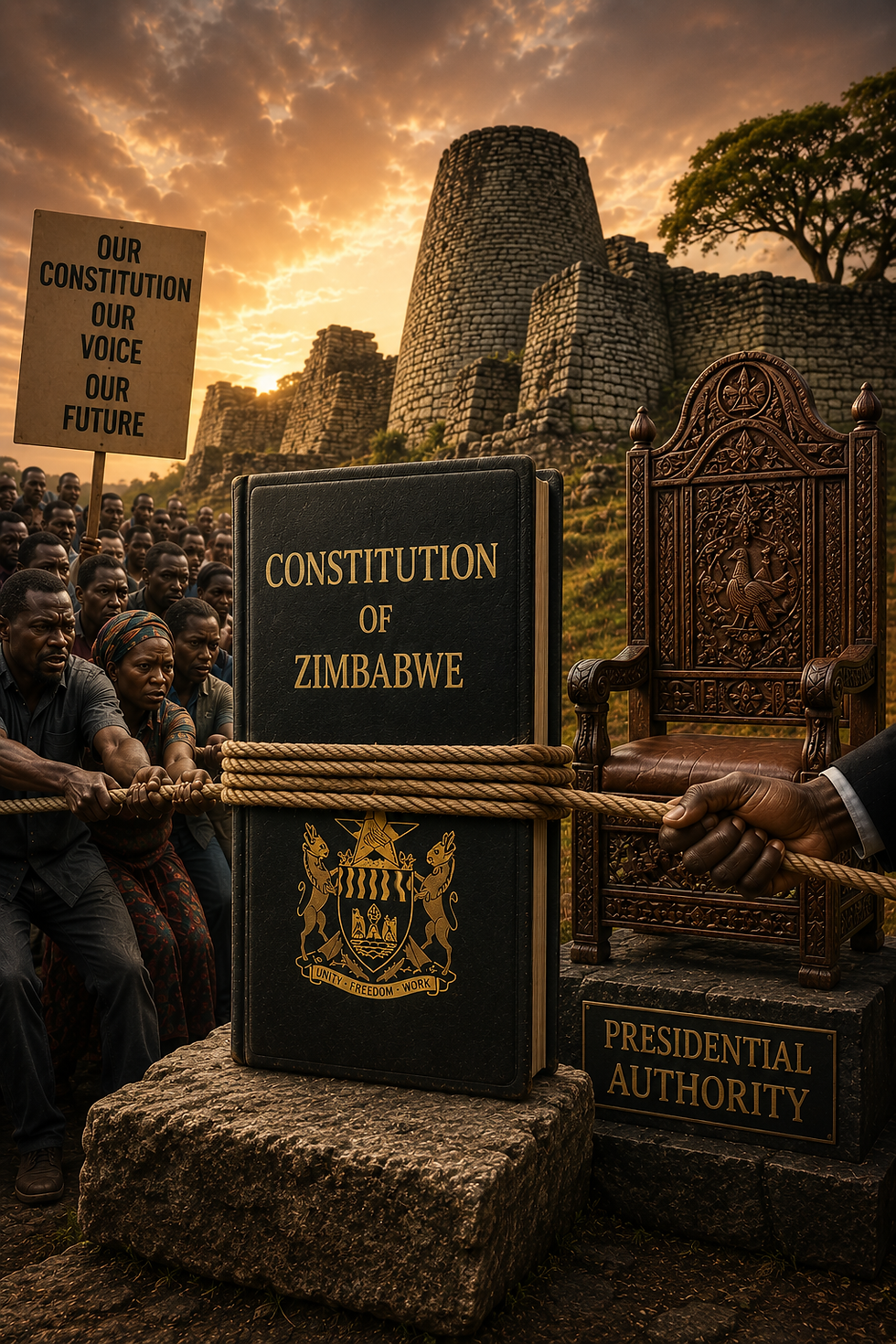
What happens when a government, without the consent of the people, becomes sufficiently powerful to alter the constitutional rules that were originally designed to restrain it?
That question has now moved from theory to reality.
Supporters of Amendment No. 3 believe the reforms will strengthen governance, promote stability, and improve the efficiency of government.
Time alone will determine whether those objectives are achieved.
Others, however, view the amendments very differently.
They see another step in a constitutional journey that has, over many decades, steadily transferred authority towards the Executive and reduced the practical restraints that a constitution is intended to impose upon those who govern.
History rarely judges constitutional amendments by the intentions of those who enact them.
It judges them by the way they are ultimately used.
That is why constitutions deserve such careful stewardship.
Their true purpose is revealed not when governments exercise power responsibly, but when they are tempted not to.
A Promise Forgotten
There is one aspect of this debate that should not be lightly dismissed.
Shortly after becoming President in 2018, Emmerson Mnangagwa was interviewed by CNN journalist Christiane Amanpour. During that interview he reaffirmed his commitment to constitutionalism, saying:
"Even if the people love me, I will still go away because I believe constitutionalism is important. In fact, we must give people the chance to have other leaders.
Ten years is not a short period. In my view, it's quite a long period, and if you have a vision, that period is long enough to implement your vision."
Those words reflected an important constitutional principle.
Power should always remain subject to constitutional restraint.
Whether the passage of Amendment No. 3 is consistent with that earlier commitment is a question each reader must answer for themselves.
For my own part, I find it difficult to reconcile the President's actions over the past year with the constitutional principles he articulated in 2018.
Zimbabwe's Constitutional Pattern
Zimbabwe's constitutional history offers little comfort.
Since the late 1980s, constitutional amendments have more often concentrated power than dispersed it.
Checks and balances have gradually weakened.
Executive authority has steadily expanded.
Institutions intended to provide independent oversight have, at various times, struggled to perform that role with the independence originally envisaged by the Constitution.
Some people may disagree about the extent to which Amendment No. 3 continues that pattern.
I, for one, believe it does.
My concern is not that the governing party has demonstrated its ability to secure the constitutional majority in both houses of Parliament necessary to amend the nation's founding document.
It is that Parliament has demonstrated its preparedness to reshape Zimbabwe's constitutional framework without seeking the direct endorsement of the electorate.
That represents a significant shift in the relationship between Parliament and the people.
Whether that ultimately strengthens Zimbabwe's democracy or weakens it will depend not merely upon the wording of the amendments, but upon how they are exercised in the years ahead.
Healthy Democracies
There is another reason for concern.
One hallmark of every healthy democracy is the realistic possibility of political change. Regular elections, while essential, are not enough. Elections must also offer citizens a genuine opportunity to replace those who govern.
Constitutions should create conditions in which governments can be replaced peacefully through the ballot box when citizens choose a different direction.
When constitutional change increasingly favours the long-term dominance of one political party, questions inevitably arise about the future vitality of democratic competition itself.
That does not mean Zimbabwe has ceased to be a democracy.
It does, however, mean that the resilience and independence of its democratic institutions deserve closer scrutiny than ever before.
Beyond Amendment No. 3
My greatest concern is not Amendment No. 3 itself.
It is the constitutional precedent it establishes.
If future constitutional changes command overwhelming parliamentary support but lack the confidence of the Zimbabwean people, the constitutional pathway through which citizens may resist those changes has become considerably narrower.
Passing constitutional amendments is a legislative act.
Building a culture of constitutional restraint takes generations.
Constitutions are not self-defending.
They rely upon citizens who understand why constitutional limits exist and who remain willing to defend those limits, regardless of which political party happens to hold power.
The principles of constitutional restraint are tested most severely when governments are politically secure and possess the parliamentary numbers to alter the rules themselves.
That is precisely when vigilance matters most.
As this chapter of Zimbabwe's constitutional history closes, another begins.
Whether future historians regard Amendment No. 3 as a measure that strengthened Zimbabwe's democracy or one that accelerated the concentration of political power cannot yet be known.
History will render that verdict.
For my own part, having lived through constitutional change in both Rhodesia and Zimbabwe over many decades, I cannot escape a deep sense of unease.
I sincerely hope that history proves my concerns to have been misplaced.
For if it does not, the greatest cost will not be borne by today's politicians.
It will be borne by the generations of Zimbabweans who inherit the constitutional choices made on their behalf.
Can the People Still Protect the Constitution?
In my previous blog I asked that question.
Having reflected further on the passage of Amendment No. 3, I have reluctantly come to the view that the answer is no longer yes.
For a constitution to be effectively protected from arbitrary or self-serving amendments, three constitutional safeguards must exist.
First, Parliament must genuinely understand that the Constitution does not belong to those who govern. It belongs to the people, and Parliament's first constitutional duty is to protect it accordingly.
Secondly, the courts, the judiciary, and every institution entrusted with upholding the rule of law must be willing, when necessary, to exercise the powers entrusted to them to prevent constitutional safeguards from being bypassed or undermined.
Finally, the electorate itself must remain sufficiently informed and motivated to vigorously defend the Constitution through the lawful exercise of democratic rights.
These three safeguards are not alternatives.
They depend upon one another.
If one weakens, the others come under greater strain.
If all three weaken together, the Constitution itself becomes increasingly vulnerable.
It is difficult to escape the conclusion that Zimbabwe has now moved perilously close to that point.
That is why the passage of Amendment No. 3 concerns me so deeply.
Not because constitutions should never change.
But because the institutions upon which constitutional government ultimately depends no longer appear to possess either the independence or the resolve necessary to prevent the concentration of power when constitutional limits are ignored or tested.
For that reason, I find it increasingly difficult to believe that the Zimbabwean people, acting alone, will be able to protect their Constitution.
History has shown that constitutions are strongest when governments willingly accept limits upon their own power.
It has also shown that once those limits begin to erode, restoring them is rarely easy.


Comments