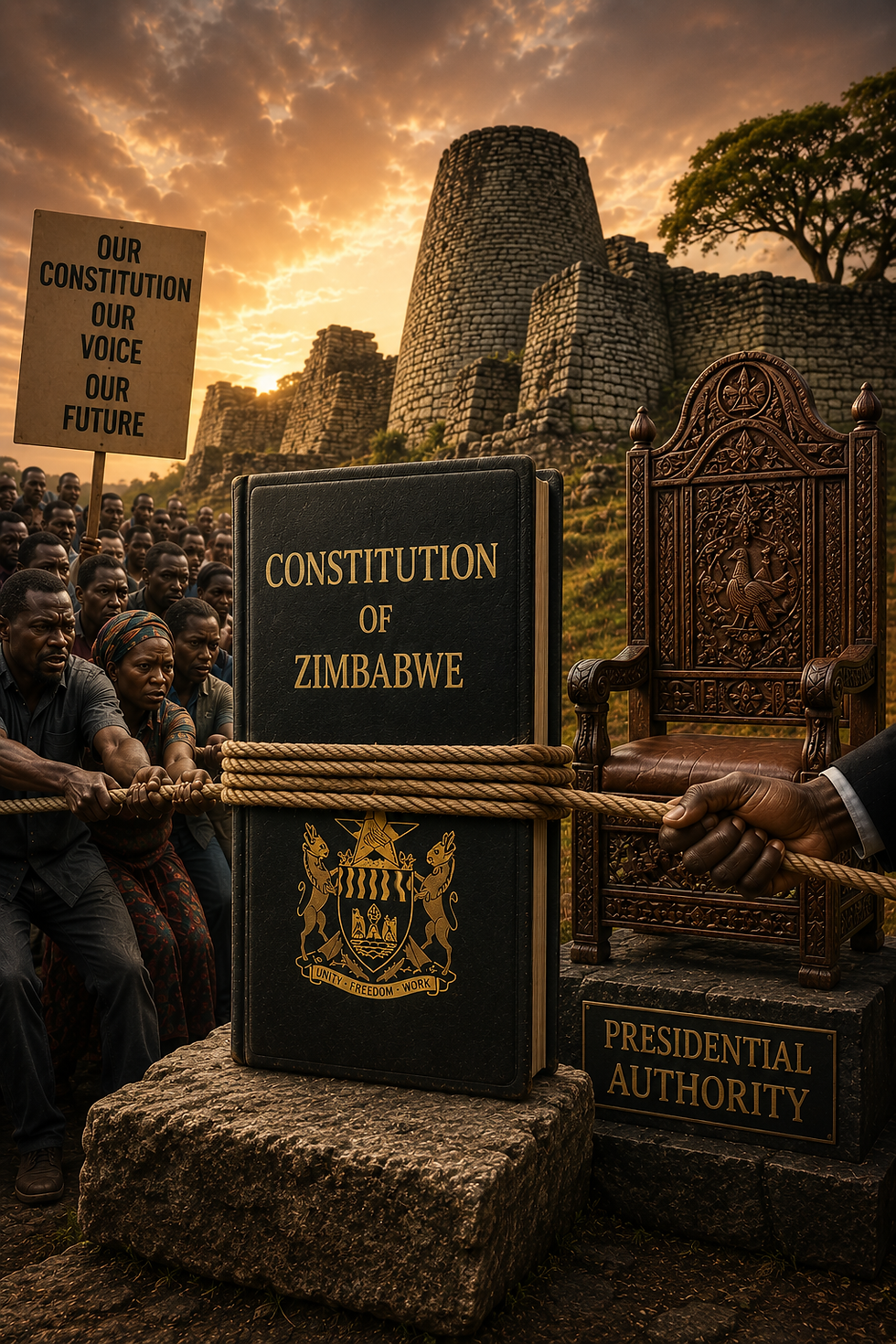
Can the People Still Protect the Constitution?
A further reflection on Zimbabwe's Constitution Amendment Bill No. 3
When I first wrote about Zimbabwe's proposed Constitution Amendment Bill No. 3 in February 2026, and again after the public consultation hearings began in April, I expressed concern that the process appeared unlikely to alter the Bill's eventual outcome.
Events over the past week have done little to change that assessment.
The National Assembly has now approved the Bill with the required two-thirds majority. Unless an unexpected political development intervenes, the Senate is also expected to do the same. If that occurs, the amendments will become part of Zimbabwe's Constitution.
Importantly, this will have occurred without the proposals first being put directly to the electorate through a national referendum.
That moment should cause all Zimbabweans to pause. Not simply because the Constitution is changing. But because of what is changing.
Constitutions exist for two purposes. They establish government. But they also restrain it.
Those two purposes are equally important.
A constitution that creates institutions without limiting their power risks becoming little more than a legal framework for concentrating power in the hands of the Executive. A constitution worthy of the name also protects citizens from the natural tendency of governments to accumulate power over time.
This is not a criticism of any particular government. It is an observation about politics itself.
Throughout history, governments of every ideology have sought greater freedom to govern with fewer constitutional constraints. Some have justified those changes in the interests of efficiency. Others have argued they were necessary for stability, national unity, or economic reform.
Sometimes those arguments have been persuasive. Sometimes they have not.
What matters is that constitutional safeguards, once weakened, are rarely restored with ease.
This pattern is not unique to Zimbabwe.
In 2017, Türkiye approved constitutional amendments that substantially expanded presidential powers. Supporters believed the changes would provide stability following years of political uncertainty. Critics feared they weakened the separation of powers. Regardless of where one stood, the decision ultimately rested with the electorate through a national referendum.
Five years later, Chile offered a different lesson. Following an extensive constitutional review, a proposed new constitution was put before the people. Despite widespread expectations that it would be adopted, Chilean voters rejected it. Whatever one's opinion of the proposal, the process demonstrated a fundamental democratic principle: constitutions derive their legitimacy from the consent of the people.
Poland provides another example. Over the past decade, reforms affecting judicial independence and constitutional oversight generated intense domestic and international debate. Elections eventually produced a change of government, illustrating that democratic institutions, when sufficiently robust, retain the capacity to direct and correct their own destiny.
These countries differ profoundly in their histories, cultures and political systems. Yet each reminds us that constitutional change is never merely a legal exercise. It is a question about where power should reside.
Zimbabwe now finds itself confronting that same question.
Supporters of Amendment Bill No. 3 argue that the changes will promote stability and improve governance. Critics argue that the changes move constitutional power further towards the Executive and further away from the citizen.
Whether history ultimately vindicates one view or the other remains to be seen.
History does, however, teach another important lesson. Democracies seldom disappear overnight. More often than not, constitutional change occurs incrementally.
A term of office is extended.
An appointment process is altered.
An oversight body becomes less independent.
Each individual change can be defended on its own merits. Only later does the cumulative effect become apparent.
That is why constitutions deserve such careful stewardship. They are not written for today's leaders.
They are written for leaders who have not yet emerged.
Every constitutional power granted today will eventually be exercised by someone else — perhaps by leaders whose values and priorities have yet to emerge.
That simple truth should encourage humility in every generation that seeks to amend its nation's founding document.
Lord Acton's famous observation remains as relevant today as when he first wrote it more than a century ago:
"Power tends to corrupt, and absolute power corrupts absolutely."
His words were never intended as an attack upon individual leaders. They were a warning about human nature.
The American jurist Learned Hand expressed a complementary, but chilling, thought:
"Liberty lies in the hearts of men and women; when it dies there, no constitution, no law, no court can save it."
Zimbabwe's constitutional journey is still unfolding. Whether Amendment No. 3 ultimately strengthens the nation or weakens its democratic foundations will not be decided by this week's parliamentary vote alone.
It will be determined over many years by how the amended Constitution is exercised, respected and defended.
Whatever one's political persuasion, one principle surely deserves broad agreement.
Constitutions should never belong to governments. They belong to nations.
And ultimately, they belong to the people.
For history suggests that when citizens gradually surrender constitutional safeguards in exchange for promises of stability or efficiency, they often discover — too late — that restoring those safeguards is far harder than preserving them in the first place.
To conclude, perhaps the most enduring lesson of constitutional history is this:
Constitutions are most vulnerable when governments are sufficiently strong to change the rules themselves without reference to the electorate.

Unfortunately it will sail through and no one will give a damn. The suffering and corruption will continue.