The Pursuit of More — What Have We Lost Along the Way?
By almost any historical measure, those of us living in the developed Western world are extraordinarily fortunate. We enjoy standards of living that previous generations could scarcely have imagined. Advances in medicine, technology, transport, and communications have transformed our lives. We live longer, travel further, communicate instantly, and enjoy comforts and conveniences that were once unimaginable luxuries.
And yet, for all this progress, are we really any happier or more content?
It is a question worth asking, particularly at a time when so many people are struggling with the rising cost of living. Housing has become increasingly unaffordable, household expenses continue to place pressure on family budgets, and many younger people wonder whether they will ever achieve the financial security their parents enjoyed.
These are genuine concerns, and it would be insensitive to suggest that those experiencing financial hardship should simply learn to be content with what they have.
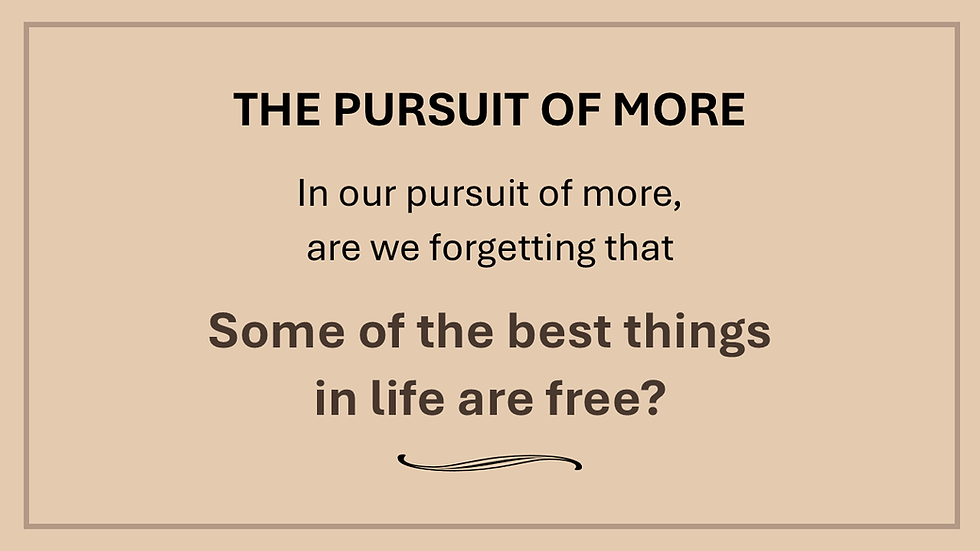
But beyond these difficulties lies a broader question. Has our relentless pursuit of greater prosperity come at a cost that we seldom stop to consider?
The relentless pursuit of more
Modern society places enormous emphasis on material success. We are encouraged to work harder, earn more, accumulate possessions, and continually improve our lifestyles. Advertising relentlessly reminds us of what we do not have, while social media provides endless opportunities to compare our lives with those of others.
The house that once seemed perfectly adequate suddenly feels too small. The car that served us well is no longer quite good enough. The holiday we thoroughly enjoyed somehow pales in comparison with someone else's photographs from an exotic destination.
Our consumer-driven economies depend heavily on encouraging us to spend, while social networking platforms increasingly reward appearances and carefully curated impressions. Political rhetoric frequently revolves around promises of greater prosperity, improved living standards, and increased government benefits.
Promises of austerity and belt-tightening rarely win elections!
Yet how often do we see the same emphasis placed on kindness, respect, generosity or service to others? These qualities may contribute far more to a fulfilling life, but they are not easily measured in economic terms and so they are ignored.
Of course, there is nothing inherently wrong with ambition or the desire to improve our circumstances. Much of the progress we enjoy today has been driven by people unwilling to accept things as they were.
But there is a difference between pursuing a better life and becoming trapped in an endless pursuit of more.
And I wonder whether, somewhere along the way, we have surrendered things considerably more valuable than the possessions we have acquired.
What have we surrendered?
Time, perhaps, is the most obvious.
We have developed extraordinary technologies designed to save time, yet many of us seem busier than ever. Instant communication has brought enormous benefits, but it has also created expectations of instant responses. Our ever-expanding cities have increased commute times. The boundaries between work and personal life have become increasingly blurred.
We have more conveniences than previous generations could have imagined, but do we necessarily have more time to enjoy life?
Then there is our appreciation of life's simpler pleasures.
Spending an afternoon with family or friends, enjoying a walk, reading a book or simply sitting quietly in the garden can bring enormous satisfaction. These experiences require little material wealth, but they do require something increasingly precious — our time, our attention, and a willingness, if only temporarily, to curtail our hunger for more.
I don't believe we have lost our ability to enjoy such moments. Rather, we have become so preoccupied with pursuing more that we sometimes fail to make sufficient time for the simpler things.
Our relationships may also have suffered. We have never been more connected through technology, yet meaningful personal relationships can sometimes take second place to digital communication and the demands of increasingly busy lives.
Perhaps the problem is not that material prosperity has deprived us of these things, but that our relentless pursuit of more has caused us to neglect some of the things that matter most.
When priorities begin to change
Having reached the age of 71, I find myself reflecting more frequently on what really matters.
In recent years, I have lost friends and family members and watched others confront serious health challenges. Experiences like these have a way of changing one's perspective.
Modern medicine has achieved extraordinary things, including extending our life expectancy. Yet living longer does not necessarily mean living better, particularly when illness, disability or declining independence diminish our quality of life.
And when we witness the difficulties faced by people close to us, things we once considered terribly important can suddenly appear rather insignificant. Ask someone struggling with a chronic condition whether they would prefer a new car or relief from their suffering!
When we are younger, it is easy to assume there will always be more time. More time to pursue ambitions, strengthen relationships, visit places we have always wanted to see or simply enjoy the company of those closest to us.
But as the years pass, we become increasingly conscious that time is not an unlimited resource.
We can aspire to acquire more possessions or accumulate greater wealth, but we cannot purchase more time.
Since retiring from my professional career, I have found considerable satisfaction in writing novels. It is challenging, occasionally frustrating and certainly not a guaranteed route to financial prosperity! But it provides a sense of purpose and the opportunity to continue learning and creating.
And perhaps that is another part of the answer. Having something worthwhile to pursue may be more important than the material rewards that pursuit brings.
Learning to recognise enough
I don't believe contentment means abandoning ambition, ceasing to strive for a better future or tolerating injustice. Nor should we feel guilty about enjoying the comforts and opportunities that prosperity provides.
But perhaps we need to become more conscious of the choices we make.
Every hour devoted to pursuing another ambition, acquiring another possession or meeting another expectation is an hour that cannot be spent elsewhere.
I am aware that our choices are not always entirely our own. Work, financial obligations, family responsibilities, and circumstances beyond our control can place considerable demands on our time.
Nevertheless, where we do have choices, perhaps we should ask ourselves whether we are giving sufficient attention to the things that matter most.
Good health, meaningful relationships, faith, a sense of purpose, and opportunities to contribute to the lives of others cannot easily be measured in financial terms.
Yet when circumstances change, it is often these less tangible gifts that we come to value the most.
Prosperity has given us extraordinary opportunities. But our relentless pursuit of more can consume the very time we need to enjoy them.
Perhaps contentment depends less on continually acquiring more and more on learning to appreciate what we already have.
Are we spending so much of our lives pursuing better days that we are forgetting to enjoy the life we already have?
I believe that is a question I need to spend more time thinking about. It boils down to finding contentment and peace in all circumstances.
A personal invitation
I hope this article has given you something to think about.
One of the pleasures of writing these occasional blogs is the opportunity to share thoughts and ideas that might encourage others to reflect on the world around them.
I would be interested to hear your thoughts on this blog. Have your own priorities changed over the years? If so, why not share your experiences in the comments below?
I would also be grateful if you would consider sharing it with a friend or family member who might also find it interesting.
They can subscribe to my blog through the Blog Subscribe page on my website and receive future articles.
Thank you for reading — and for your continued interest in my writing.


Comments